- Keep their diet the same - most boarding facilities will encourage you to bring your pet's diet with you to help decrease the chance of gastrointestinal upset (ie vomiting or diarrhea). To make it even easier on the facility, we advocate that you portion out your pet's meals into individualized Ziploc baggies so that the employees can just dump a baggie into a bowl for your pet. This also reduces any chances that your pet may get under or overfed while you are out of town.
- Bring any medical records - Most boarding facilities will want copies of your pet's medical records or vaccine history - often your vet can send these to them via fax or email however I recommend bringing a copy with you as well. Sometimes fax/email doesn't go through and you don't want to be turned away for lack of records
- Check on vaccinations early! - Each boarding facility requires different vaccinations for boarding - some even require negative fecal checks or heartworm testing. It is also advisable that your pet receive any required vaccinations 10 days prior to their boarding appointment - this is because vaccinations work by creating an immune response to the vaccine, AND this does NOT happen as soon as the vaccine is given. So if you are planning to swing by your vet on the way to the boarding facility, be aware - your pet will NOT be protected by those vaccines it just received.
- Visit the facility first - just like a daycare or school situation, you want a chance to see the facility before your baby is staying there. Most boarding places will invite you to come tour the facility and meet staff prior to your pet's boarding reservation. Some may even offer a free trial visit in which your pet will get to stay for a few hours and interact with staff and other boarders. This is particularly important if you plan to do any doggie playtime while your pet is there - you don't want to find out that your pet doesn't socialize well with other dogs when you are far away!
- Ask about optional services - this can include extra playtime, doggie baths, spa time, one-on-one playtime or even swimming/agility time. Each facility is different but you want to make sure your pet is staying as engaged as possible while you are out of town.
- Bring some comforts from home - Again, check with the particular facility to see what they allow you to bring but we know that bringing things from home can reduce stress for your pets while you are away. Even their own bed, toys or a shirt that you have recently worn can help reduce the anxiety of being away from home.
- Book early - Boarding books up fast - especially around major holidays such as 4th of July, Labor Day etc - make sure you get your reservation in early!
- Ask about emergency/veterinary care - Often boarding facilities will work alongside a veterinary hospital near by to provide any needed medical care while your pet is in their care. It is best to discuss with them any financial constraints or limits you have in terms of medical care for your pet before you are faced with an emergency decision.
Wednesday, April 25, 2018
Boarding your pet this summer
The weather is warming up which means it is time to start planning your family trips - even if just for a weekend away, taking some time away from Fluffy or Fido is inevitable this summer. We have a few tips to make your time away from your fur baby less stressful for everyone:

Monday, April 16, 2018
Just a few drops
As we have mentioned previously, heartworm disease is a progressive and serious disease which can become fatal if undetected and/or left untreated. Yearly heartworm testing is recommended, even for those pets receiving heartworm prevention, to help detect disease early on. Most patients do not show symptoms of disease early on.
Heartworm disease is detected via a blood test - often a test can be performed in the veterinary office however sometimes a sample has to be sent to an outside lab for confirmation ( often the case in cats because, of course, they cannot be simple!). The test works by detecting the presence of heartworm proteins within the blood stream. For dogs, a positive on the in house test is usually confirmatory however in cats, a secondary test must be sent out to the lab to determine if they are actively infected or just retaining antibodies from previous exposure.
Annual testing is recommended, even if your pet is on yearly heartworm prevention. This test helps to ensure that the prevention is working and there have been no lapses in protection - let's face it, we all know at least 1 dog who spits the pill out when mom or dad aren't looking. Heartworm prevention is highly effective however nothing is 100% and we want to ensure your pets are not at risk. Beyond that, most heartworm prevention manufacturers will stand behind their products IF purchased through a licensed veterinarian and a yearly heartworm test is performed - this means that if Fido is taking his heartworm prevention each and every month but he tests positive, the manufacturer will often pay for a large portion (if not all) of his heartworm treatment. It's just a nice, peace-of-mind measure that by following your veterinarian's recommendation your pet is covered - both medically and financially.
We hope that you learned a little something through our heartworm disease poll - stay tuned for more questions and check out www.chestnutarborvet.com for more information regarding our hospital and the difference in veterinary care.
Heartworm disease is detected via a blood test - often a test can be performed in the veterinary office however sometimes a sample has to be sent to an outside lab for confirmation ( often the case in cats because, of course, they cannot be simple!). The test works by detecting the presence of heartworm proteins within the blood stream. For dogs, a positive on the in house test is usually confirmatory however in cats, a secondary test must be sent out to the lab to determine if they are actively infected or just retaining antibodies from previous exposure.
Annual testing is recommended, even if your pet is on yearly heartworm prevention. This test helps to ensure that the prevention is working and there have been no lapses in protection - let's face it, we all know at least 1 dog who spits the pill out when mom or dad aren't looking. Heartworm prevention is highly effective however nothing is 100% and we want to ensure your pets are not at risk. Beyond that, most heartworm prevention manufacturers will stand behind their products IF purchased through a licensed veterinarian and a yearly heartworm test is performed - this means that if Fido is taking his heartworm prevention each and every month but he tests positive, the manufacturer will often pay for a large portion (if not all) of his heartworm treatment. It's just a nice, peace-of-mind measure that by following your veterinarian's recommendation your pet is covered - both medically and financially.
We hope that you learned a little something through our heartworm disease poll - stay tuned for more questions and check out www.chestnutarborvet.com for more information regarding our hospital and the difference in veterinary care.
Friday, April 13, 2018
If It's OTC....it ain't the real deal
There is a reason why heartworm prevention must be bought from a licensed veterinarian - that reason....it's a medication (ie a drug). The Food and Drug Administration oversees prescription medications dispensed by veterinarians and therefore the label for heartworm prevention states that it must be prescribed by a licensed veterinarian. What does that mean.....if you are buying something OTC (over-the-counter), ie. Frontline or Hartz or Advantage, then it is NOT a heartworm preventative. Yes they may state on the label that they prevent mosquitoes but they are not preventing heartworm disease.
Whether you choose to purchase a topical product (ie. Advantage Multi) or a chewable tablet/pill (ie Interceptor Plus or Heartgard Plus) or an injectable heartworm preventative (ie Proheart 6) - all heartworm prevention works in the same way. They are designed to eliminate the immature (larval) stage of the heartworms. This includes the infective stage that the mosquito deposits when it bites but also the larval stage that develops over the next 30 days. That being said, it only takes 51 days for a heartworm to mature to the adult stage and our monthly heartworm prevention is no longer able to eliminate this form. This is why keeping your pet on a monthly heartworm prevention (or every 6 month in the case Proheart6) is so important!
The nice thing about most heartworm prevention these days is it is multi-purpose - being it does more than just eliminate heartworms. Most products are also labeled to eliminate intestinal parasites such as roundworms, hookworms, whipworms, and even tapeworms for some products. Some all in one products may also prevent fleas however it is important to discuss this with your veterinarian as some products may not kill fleas but rather prevent them from breeding.
Just remember - if you can buy it without a prescription or without seeing your veterinarian, then it isn't heartworm prevention!
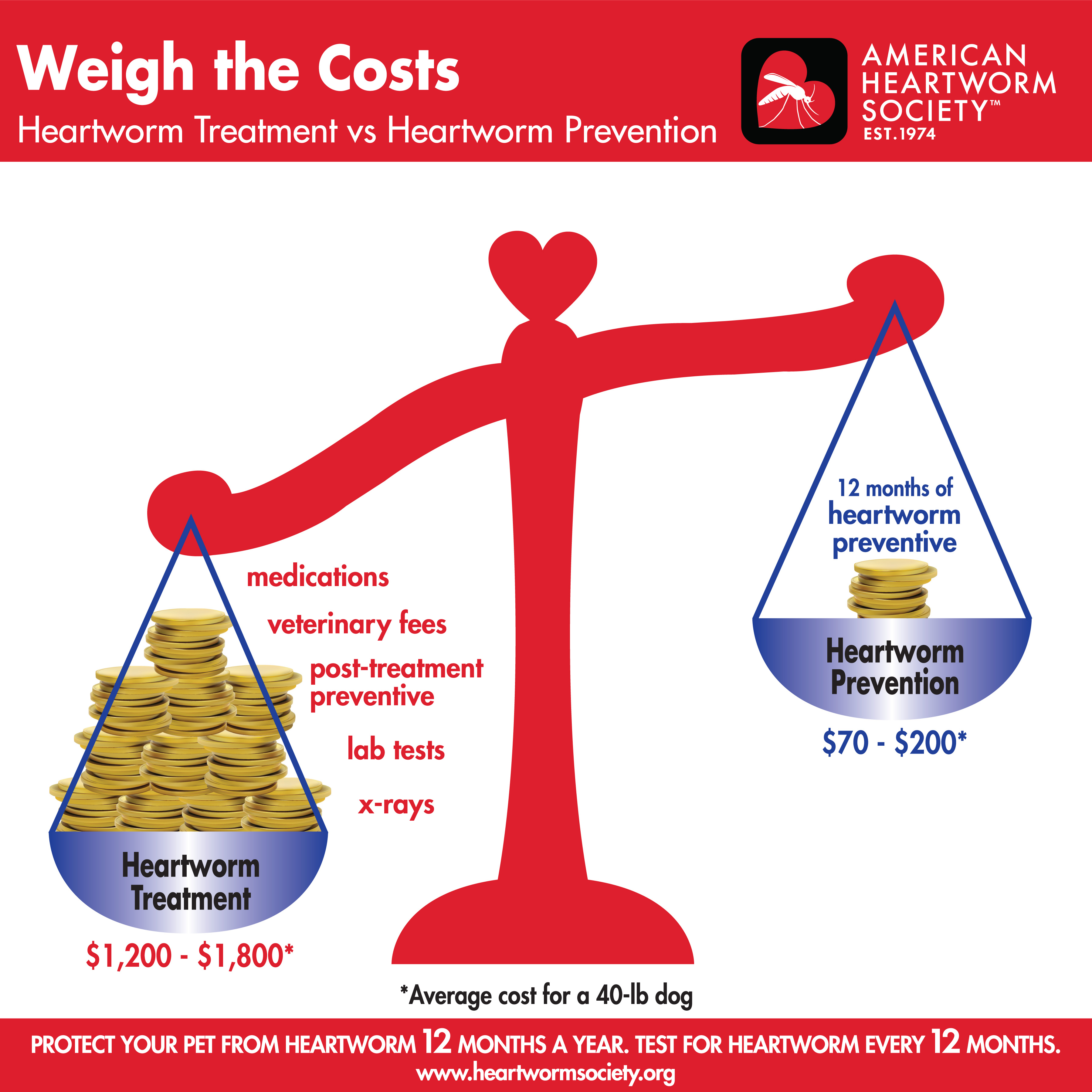
Whether you choose to purchase a topical product (ie. Advantage Multi) or a chewable tablet/pill (ie Interceptor Plus or Heartgard Plus) or an injectable heartworm preventative (ie Proheart 6) - all heartworm prevention works in the same way. They are designed to eliminate the immature (larval) stage of the heartworms. This includes the infective stage that the mosquito deposits when it bites but also the larval stage that develops over the next 30 days. That being said, it only takes 51 days for a heartworm to mature to the adult stage and our monthly heartworm prevention is no longer able to eliminate this form. This is why keeping your pet on a monthly heartworm prevention (or every 6 month in the case Proheart6) is so important!
The nice thing about most heartworm prevention these days is it is multi-purpose - being it does more than just eliminate heartworms. Most products are also labeled to eliminate intestinal parasites such as roundworms, hookworms, whipworms, and even tapeworms for some products. Some all in one products may also prevent fleas however it is important to discuss this with your veterinarian as some products may not kill fleas but rather prevent them from breeding.
Just remember - if you can buy it without a prescription or without seeing your veterinarian, then it isn't heartworm prevention!
Thursday, April 12, 2018
It's EVERYWHERE

Every 3 years the American Heartworm Society gathers data to show the impact of heartworm disease on the United States. Even if heartworms do not appear to be a significant risk in your local area, traveling with your pet to an area where heartworm disease is more prevalent can put your fur baby at risk. Taking into account the spread of wildlife that are hosts for heartworm disease, such as foxes, coyotes and wolves, you can see that heartworm disease can be spread easier than you realize.
Mosquitoes can also travel long distances thereby spreading disease, in addition, pets that are translocated from one area to another can bring heartworm disease into areas where it had previously not been a problem - an example of this is following Hurricane Katrina, when 250,000 pets were relocated.
The fact is heartworm disease HAS been diagnosed in all 50 states and unfortunately, risk factors are impossible to predict. Remember, it takes only 1 mosquito bite to infect your pet. The American Heartworm Society advocates for the "Think 12" campaign - test your pet every 12 months and use heartworm prevention for all 12 months of the year.
Wednesday, April 11, 2018
Cats are NOT small dogs
Like dogs, cats can become infected with heartworm disease. However, unlike dogs, cats are not the ideal host for heartworms, therefore some infections can clear on their own, although leaving behind permanent lung damage. Heartworms can also lead to significant lifelong problems in cats such as wheezing, coughing and difficulty breathing - some even speculate that cats affected with asthma were originally infected with heartworms thereby leading to the chronic airway inflammation characteristic of feline asthma.
While dogs become infected with >30-50 heartworms, most cats have 6 or fewer adult heartworms causing disease. Sometimes, even 1 single heartworm can infect a cat and cause disease. Unfortunately, unlike their canine counterparts, there is NO effect heartworm treatment for cats. Most times, cats will clear the infection on their own however our job as veterinarians is to help treat them for the secondary respiratory damage created by the parasites. Often this means low doses of anti-inflammatories such as prednisolone and frequent monitoring via chest x-rays and lab-work.
Since there is no effective treatment for heartworm disease in cats, it is of utmost important that cat owners consider starting their feline friends on heartworm prevention - even if they are indoor only kitties. As mentioned in yesterday's post - even 1 single mosquito entering your home can be enough to expose and infect your kitty.
Tuesday, April 10, 2018
Shooo.....mosquito?
And the answer is....Mosquito! Heartworm disease is a potentially fatal disease of companion animals in North America. Spread by the mosquito, heartworms are parasitic worms that live in the heart, lungs and pulmonary vessels of dogs and cats. If left untreated, heartworm infection can lead to heart and liver failure as well as damage to other organ. Heartworm disease can affect dogs, cats, ferrets as well as foxes, coyotes, wolves, sea lions and even....HUMANS.
Mosquitoes play an integral part in the life-cycle of the heartworm - adult female heartworms living in a fox or dog produce microscopic babies (microfilaria) that circulate in the bloodstream. When a mosquito bites an infected host and takes a blood meal, the microfilaria are picked up as well. These baby worms then mature into larvae over the next 10-14 days. Then when that same mosquito bites its next victim (dog, cat or human) the infected larvae are deposited into the skin and enter the new host via the mosquito's bite wound. Once inside the host, it takes 6 months for the larvae to mature into adult heartworms. Once mature, adult heartworms can live up to 7 years in a dog or 3 years in a cat.
Each mosquito season means a risk to our companion animals due to the chance of becoming infected with heartworms. Even if a pet spends the majority of its lifetime inside, it is possible for an infected mosquito to gain access to the home and infect the animal. For this reason, we always recommend that our pets stay on heartworm prevention year-round
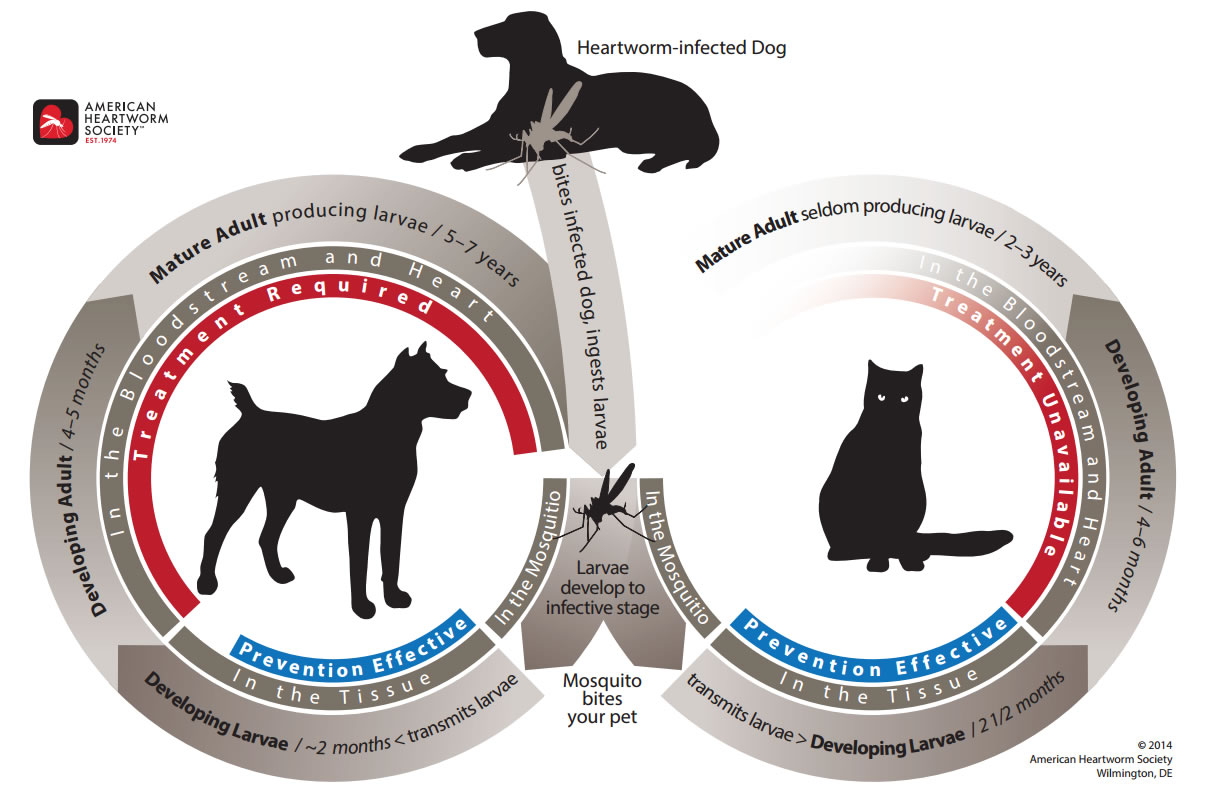
Mosquitoes play an integral part in the life-cycle of the heartworm - adult female heartworms living in a fox or dog produce microscopic babies (microfilaria) that circulate in the bloodstream. When a mosquito bites an infected host and takes a blood meal, the microfilaria are picked up as well. These baby worms then mature into larvae over the next 10-14 days. Then when that same mosquito bites its next victim (dog, cat or human) the infected larvae are deposited into the skin and enter the new host via the mosquito's bite wound. Once inside the host, it takes 6 months for the larvae to mature into adult heartworms. Once mature, adult heartworms can live up to 7 years in a dog or 3 years in a cat.
Each mosquito season means a risk to our companion animals due to the chance of becoming infected with heartworms. Even if a pet spends the majority of its lifetime inside, it is possible for an infected mosquito to gain access to the home and infect the animal. For this reason, we always recommend that our pets stay on heartworm prevention year-round
Monday, March 26, 2018
The Age-Old Adage
Everyone has heard the age-old adage, 'a dog ages 7 years for every 1 human year' and we all make assumptions based on that adage as to how old our pets are in 'human years'. It is true that our pets age faster than we do and thus have a shorter life expectancy. It also means that we need to consider certain things as they age which means qualifying them as senior and geriatric earlier than we would their human counterparts.
Now, I'm not out here trying to put labels on your pets but I am advocating for them - why, you ask? As pets age, and since we have established that they age quicker than we do, certain organs start to change and certain diseases can become more apparent. While we might like to think that 5 year old Fido is still a spring chicken, the odds are that depending on his breed and body size, he may already be creeping into senior citizen status.
Since pets age faster than us and their life expectancy is shorter, a pet that is age 5-8 (or approximately 40-50 in human years) is already halfway through their lifespan . And in some cases, with large breed dogs for example, they are well beyond the halfway mark.
In veterinary medicine, it used to be that any pet over the age of 7 was considered a senior pet - that's just not the case anymore. Our smaller breed dogs and cats are not considered to be senior citizens until after the age of 9 however giant breed dogs reach senior status at age 6. While this may seem trivial, the age and rate at which our pets become adults, seniors and geriatrics affects the type of diagnostics we as doctors recommend as well as our expectations for their lifespan.
Just like in human medicine, as we age our doctors may recommend more advanced testing due to aging of our organs and body systems. The same holds true for our pets - a 1 year old Bichon may only require an annual exam, vaccinations and heartworm/fecal parasite checks; however a 10 year old cat will likely require bi-annual wellness visits, vaccinations, annual labwork, thyroid monitoring, urinalysis, blood pressure checks and ideally some form of imaging (ultrasound preferably) to monitor her kidneys and intestines. It's the difference between taking my 4 year old to the doctor and my 40 year old self to the doctor - different expectations, different tests, different recommendations.
As our pets age it is often easy to overlook some of the subtle symptoms of disease - we often think that these things happen due to 'old age'. But is it old age? What if we were screening for these things earlier and could catch diseases sooner? Could Fluffy have more years with our family? When you are bringing your pet into the vet its important to start thinking about their behavior at home - some examples include, are they sleeping all night long or are they waking up to go outside? Have you noticed any bathroom accidents in the home? Do they seem to be experiencing some vision issues? Is your cat not grooming herself like she used to? Does Fido take longer to greet you at the door or perhaps he doesn't even realize you have come home? Maybe Scout is having trouble going up and down steps or Callie is drinking more water? If you think it's important, tell us! Even if you don't think it's important! Because old age is not a disease, but there are diseases linked to aging - so let's get on top of them sooner and maybe Fido will live to be 110!

Now, I'm not out here trying to put labels on your pets but I am advocating for them - why, you ask? As pets age, and since we have established that they age quicker than we do, certain organs start to change and certain diseases can become more apparent. While we might like to think that 5 year old Fido is still a spring chicken, the odds are that depending on his breed and body size, he may already be creeping into senior citizen status.
Since pets age faster than us and their life expectancy is shorter, a pet that is age 5-8 (or approximately 40-50 in human years) is already halfway through their lifespan . And in some cases, with large breed dogs for example, they are well beyond the halfway mark.
In veterinary medicine, it used to be that any pet over the age of 7 was considered a senior pet - that's just not the case anymore. Our smaller breed dogs and cats are not considered to be senior citizens until after the age of 9 however giant breed dogs reach senior status at age 6. While this may seem trivial, the age and rate at which our pets become adults, seniors and geriatrics affects the type of diagnostics we as doctors recommend as well as our expectations for their lifespan.
Just like in human medicine, as we age our doctors may recommend more advanced testing due to aging of our organs and body systems. The same holds true for our pets - a 1 year old Bichon may only require an annual exam, vaccinations and heartworm/fecal parasite checks; however a 10 year old cat will likely require bi-annual wellness visits, vaccinations, annual labwork, thyroid monitoring, urinalysis, blood pressure checks and ideally some form of imaging (ultrasound preferably) to monitor her kidneys and intestines. It's the difference between taking my 4 year old to the doctor and my 40 year old self to the doctor - different expectations, different tests, different recommendations.
As our pets age it is often easy to overlook some of the subtle symptoms of disease - we often think that these things happen due to 'old age'. But is it old age? What if we were screening for these things earlier and could catch diseases sooner? Could Fluffy have more years with our family? When you are bringing your pet into the vet its important to start thinking about their behavior at home - some examples include, are they sleeping all night long or are they waking up to go outside? Have you noticed any bathroom accidents in the home? Do they seem to be experiencing some vision issues? Is your cat not grooming herself like she used to? Does Fido take longer to greet you at the door or perhaps he doesn't even realize you have come home? Maybe Scout is having trouble going up and down steps or Callie is drinking more water? If you think it's important, tell us! Even if you don't think it's important! Because old age is not a disease, but there are diseases linked to aging - so let's get on top of them sooner and maybe Fido will live to be 110!

Wednesday, February 28, 2018
Spring is coming....are you ready?

The warm weather is starting - it's one of my favorite times of year. It feels like everyone is waking up and getting outside. People just seem happier. Our pets are happier too - the days of being stuck indoors or going out for short walks are coming to an end. This past weekend my dogs enjoyed spending time out on the patio as I enjoyed a nice evening fire, food and music with friends. Springtime also means reemergence of pesky pests - namely fleas and ticks. These pesky insects are not only annoying but can carry some pretty scary diseases that can affect not only your pets but also you. Scary words like Lyme Disease, Anaplasma, Ehrlichia, Cytauxzoon and Babesia come to mind when we think of flea and tick borne diseases. As medical professionals, and pet owners, we want to minimize our patients' risks of contracting some of these diseases. And as pet parents, we know you want to keep your pets protected and comfortable!
There are many options to choose from when trying to keep your pets protected from fleas and ticks - there are topical options, over the counter medications, sprays, powders, tablets, collars....its enough to make even the most educated person scratch their head (hopefully not from fleas tho!). We know that it is confusing and all the options can seem similar. At Chestnut Arbor Veterinary Hospital we have looked at all the options and chosen the ones that we feel provide the best protection for you in the shortest amount of time after application or ingestion and are the best value for your money. We also take into account the lifestyle of your pet as well as any other factors such as tiny humans or other pets in the home for which some products may not be safe.
At our office we narrow our selection down - we have 2 oral tablets for our canine friends as well as a collar for larger patients. Our feline friends have 1 option. No guess work here - we will help you decide which is best for your pet and we stand behind the choices we have made. Looking for something we don't keep in stock? No worries - you can find it on our online pharmacy and have it shipped right to you.
We want to make sure all our pets are protected and comfortable as the weather warms up - during the month of March we are offering a special discount on our flea and tick products when purchased as 3 or 6 month supplies. Check with us today to see what option is best for your pet and keep them pest free!
Friday, January 12, 2018
Thursday, December 21, 2017
Chestnut Arbor Veterinary Hospital's Top 10 List
We keep promoting that our office is Fear Free - but many people don't know what that means...so I have compiled the list of the 10 things we do as a Fear Free clinic to make you and your pets more comfortable. So here is the top 10 list of what you can expect when you visit us at Chestnut Arbor Veterinary Hospital:
10 - Emotional Notecard- We note that your pet's emotional response is when they visit us - and we notate what works and what doesn't work for your pet. This means on your pet's medical chart it will state - 'likes peanut butter' or 'does well when mom holds in her lap'. We take notice so we can make future visits better.
9- Just say Yes - to pre-visit drugs that is - Drugs are not a bad word in our hospital - often pets need a little something to reduce anxiety before a visit - we can help with that. Whether it be a natural hormone (like milk hormone) or a stronger pharmaceutical like Trazodone - we can prescribe the right medication to alleviate any anxiety your pet may have
8 - No trips to the "BACK" - We keep you and your fur-baby together as much as we can during your visit. This means procedures will be done with you in the exam room unless you request otherwise or an extenuating circumstance requires us to separate you from your pet. If we need to use any particular equipment located in our treatment area, often we will suggest you accompany us and your fur-baby.
7 - Distraction is key - In order to facilitate procedures being done in a fear free way, often our team members will use toys to distract your pet. That means you can bring Fluffy's favorite stuffed animal to her visit!
6 - No white coats here - The white-coat phenomenon is a real thing in both human and veterinary medicine - therefore our staff does not wear white coats (sidenote, I have never really liked wearing one so this was an easy transition for me!). Most often our team is in scrubs or casual attire to help your pet feel more at home.
5 - Food is the way to their heart - Bring your pets hungry! Not only does fasting ensure better lab results but our goal is to offer your pets 60-100 treats during their visit. That's right - we totally and intentionally want to spoil them and bribe them to love us! And what better way then thru yummy treats. In fact you will be presented with a species specific menu to choose from and let our staff know what kinds of yummy foods your pet likes. Dietary restrictions ??? - no problem, we have hypoallergenic alternatives OR even better, you can bring their food/treats from home!
4 - We look YOU in the eye - eye contact is stressful for pets so you will notice when our staff enters an exam room, we will make eye contact with you but not your fur-baby. Often we will even seem like we are ignoring your baby at first - in reality we are giving them a chance to check us out before we engage them. This gives them a sense of relief and calm, and allows us to get to know you as well!
3 - What's that smell? - Our rooms are equipped with pheromone diffusers - you won't be able to smell them but your pets do! Pheromones are pet-friendly substances that are detected by the central nervous system and help calm your pet. We even spray ourselves with them before entering a room
2- No slippery signs here - Exam room tables, slippery floors, metal scales - these all induce fear and stress in our pets. You will notice that we use yoga mats, blankets and do our procedures/exams on the floor where pets are most comfortable. For those that prefer to be up high we will create a comfortable environment for them on an elevated surface.
And the #1 thing - No waiting here! - Once you enter our office you will be greeted, by name, and placed directly into an exam room so your pet, and you, can relax. The rooms are designed with you and your pet in mind - comfy chairs, relaxing dog beds, cat perches and trees, and calming music greet you in our exam rooms and hopefully make you feel at home.
So there you have it - there is our top 10 list of what we do as a Fear Free Hospital to make you and your fur-baby feel at home. Check out our facebook page (www.facebook.com/chestnutarborvet) for more information.

10 - Emotional Notecard- We note that your pet's emotional response is when they visit us - and we notate what works and what doesn't work for your pet. This means on your pet's medical chart it will state - 'likes peanut butter' or 'does well when mom holds in her lap'. We take notice so we can make future visits better.
9- Just say Yes - to pre-visit drugs that is - Drugs are not a bad word in our hospital - often pets need a little something to reduce anxiety before a visit - we can help with that. Whether it be a natural hormone (like milk hormone) or a stronger pharmaceutical like Trazodone - we can prescribe the right medication to alleviate any anxiety your pet may have
8 - No trips to the "BACK" - We keep you and your fur-baby together as much as we can during your visit. This means procedures will be done with you in the exam room unless you request otherwise or an extenuating circumstance requires us to separate you from your pet. If we need to use any particular equipment located in our treatment area, often we will suggest you accompany us and your fur-baby.
7 - Distraction is key - In order to facilitate procedures being done in a fear free way, often our team members will use toys to distract your pet. That means you can bring Fluffy's favorite stuffed animal to her visit!
6 - No white coats here - The white-coat phenomenon is a real thing in both human and veterinary medicine - therefore our staff does not wear white coats (sidenote, I have never really liked wearing one so this was an easy transition for me!). Most often our team is in scrubs or casual attire to help your pet feel more at home.
5 - Food is the way to their heart - Bring your pets hungry! Not only does fasting ensure better lab results but our goal is to offer your pets 60-100 treats during their visit. That's right - we totally and intentionally want to spoil them and bribe them to love us! And what better way then thru yummy treats. In fact you will be presented with a species specific menu to choose from and let our staff know what kinds of yummy foods your pet likes. Dietary restrictions ??? - no problem, we have hypoallergenic alternatives OR even better, you can bring their food/treats from home!
4 - We look YOU in the eye - eye contact is stressful for pets so you will notice when our staff enters an exam room, we will make eye contact with you but not your fur-baby. Often we will even seem like we are ignoring your baby at first - in reality we are giving them a chance to check us out before we engage them. This gives them a sense of relief and calm, and allows us to get to know you as well!
3 - What's that smell? - Our rooms are equipped with pheromone diffusers - you won't be able to smell them but your pets do! Pheromones are pet-friendly substances that are detected by the central nervous system and help calm your pet. We even spray ourselves with them before entering a room
2- No slippery signs here - Exam room tables, slippery floors, metal scales - these all induce fear and stress in our pets. You will notice that we use yoga mats, blankets and do our procedures/exams on the floor where pets are most comfortable. For those that prefer to be up high we will create a comfortable environment for them on an elevated surface.
And the #1 thing - No waiting here! - Once you enter our office you will be greeted, by name, and placed directly into an exam room so your pet, and you, can relax. The rooms are designed with you and your pet in mind - comfy chairs, relaxing dog beds, cat perches and trees, and calming music greet you in our exam rooms and hopefully make you feel at home.
So there you have it - there is our top 10 list of what we do as a Fear Free Hospital to make you and your fur-baby feel at home. Check out our facebook page (www.facebook.com/chestnutarborvet) for more information.
Wednesday, December 20, 2017
Find the passion in vet med
There comes a point in every vet's career when they think - 'is this it?'. Is this what I went to school for - is that what I will do forever? For some it is a fleeting and passing thought but for others, I think it is a turning point. Some people opt to leave the field and find something else to do, some people get out of clinical practice and go into industry or sales and others have to find their passion for this career again.
When I became director of a local ER department I thought I had reached the pinnacle of my career. I was working at a highly regarded hospital, with awesome staff and amongst a group of highly talented and educated doctors. I was getting a chance to see cases I had never seen before and getting to perform procedures weekly that some doctors only perform once in their entire career. I was helping to educate and train new graduate veterinarians and inexperienced technical staff. I was living the dream - or so I thought.
I loved ER - the rush of it all, the fun of not knowing what was coming in the door and the excitement when you saved a life and helped a client. ER has its darkness as well (and not just because we worked at night). Many of my cases ended in sadness - either due to the medical issues of the pet or lack of finances of the owner. Sometimes my cases ended before they started and more often than I care to recall, patients were presented to me solely for euthanasia. Those cases wear on you - emotionally, mentally, physically....and I fell victim to compassion fatigue and burnout. I regret to say that by the time I left my position as a full time ER doctor I had become cold and hardened and frankly I didn't care. I knew something had to change - I thought going back to day practice where I would have a more normal schedule and could see my daughter on weekends and holidays would help. And getting some regular sleep and doses of vitamin D on a daily basis did help, but I still found myself wondering - 'is this really the career I longed for when I was 5 years old'. I just didn't feel the passion and the sense of fulfillment that I once did. I knew it was possible to still be excited about this field - but I needed to find something to reignite my love for what I did.
When I decided to open my own practice, I also made the committment to make it Fear Free - and that is where I found my passion again. Part of my desire to open my own hospital was so that I could practice medicine 'my way'. I knew there had to be a better way to do things - a way that clients could see the value in the experience and a way that pets were happy to come to the veterinary office and a way that gave me that inner satisfaction that I longed for. Becoming Fear Free Certified reinstilled my passion and reignited my desire for this career. I began using techniques at the practice I was working at before I opened Chestnut Arbor Veterinary Hospital, and I could begin to see the difference it made for both the pets and the owners. I knew that this was it - this was what I needed to make me feel fulfilled again as a doctor and even more so as a practice owner. I knew it would take time to adjust and create the type of practice where clients see the value in this type of approach. So our practice moves a little slower - we take our time getting to know clients and patients. We spend time allowing pets to get to know us and we don't force them to do anything they don't want to do. And this is an adjustment for everyone - clients, nurses, even myself as a doctor. But seeing a pet who was scared to visit us, now come in wagging its tail and allow us to examine it while it eats some yummy snacks - that is worth it.
When someone asks why we are Fear Free - I say, why would someone not want to be Fear Free?
Friday, December 8, 2017
Tuesday, December 5, 2017
We have pets too
It's easy to forget that veterinary professionals have pets at home and when those pets get ill, or develop problems, often times our minds go into overdrive. We are amon
gst that group of people that have enough knowledge to be dangerous and therefore as soon as one of our animals limps, coughs, or vomits, our minds automatically jump to the worst possible conclusion out there. You will find that when it comes to our own pets, we lose all sense of medical knowledge in that immediate moment. I can't help but think of the time my sweet Madeline (a now 5 year old boxer) was only about 12 weeks old and choking on a piece of bedding - from a bed that she had nicely destroyed while at the hospital with me for my overnight ER shift. I completely lost my cool, forgot all sense of emergency veterinary experience I had, and instead handed her off to my colleague to deal with her because at that moment I was not a doctor - I was a pet parent. Luckily she was fine and continues to shred bedding when at the hospital with me.
 I tell you this story to say, we know what you are going through when your pets are sick. Please don't think for a second that just because we see these things day in and day out, that we aren't affected by it or that we can't relate or empathize to your concerns. We know how scary it can be when your pet is hurt or how worrisome it can be when they just haven't been themselves for a few days. We know how it feels to hear that your pet has cancer, is diagnosed with seizures or needs more extensive testing. My 8 year old Boxer had a seizure today while with me at work - I know how scary those are and just sitting there with him while he recovered, I am thankful for the knowledge I have as a doctor and that I can empathize with my clients. I can relate because I have been there - and I think that helps make us better doctors.
So ask us about our pets - ask us our opinion on what you should do in situations - the odds are, we have been there too.
gst that group of people that have enough knowledge to be dangerous and therefore as soon as one of our animals limps, coughs, or vomits, our minds automatically jump to the worst possible conclusion out there. You will find that when it comes to our own pets, we lose all sense of medical knowledge in that immediate moment. I can't help but think of the time my sweet Madeline (a now 5 year old boxer) was only about 12 weeks old and choking on a piece of bedding - from a bed that she had nicely destroyed while at the hospital with me for my overnight ER shift. I completely lost my cool, forgot all sense of emergency veterinary experience I had, and instead handed her off to my colleague to deal with her because at that moment I was not a doctor - I was a pet parent. Luckily she was fine and continues to shred bedding when at the hospital with me.
 I tell you this story to say, we know what you are going through when your pets are sick. Please don't think for a second that just because we see these things day in and day out, that we aren't affected by it or that we can't relate or empathize to your concerns. We know how scary it can be when your pet is hurt or how worrisome it can be when they just haven't been themselves for a few days. We know how it feels to hear that your pet has cancer, is diagnosed with seizures or needs more extensive testing. My 8 year old Boxer had a seizure today while with me at work - I know how scary those are and just sitting there with him while he recovered, I am thankful for the knowledge I have as a doctor and that I can empathize with my clients. I can relate because I have been there - and I think that helps make us better doctors.
So ask us about our pets - ask us our opinion on what you should do in situations - the odds are, we have been there too.
Friday, November 24, 2017
What Makes us Different
As I embark on this new journey of practice ownership, I knew I had to set my hospital apart from the rest. Let's be honest, there are a LOT of veterinary offices out there. And often we do the same types of things - we offer preventative care (i.e. vaccines, deworming, heartworm and flea prevention) as well as routine surgeries, dental cleanings, x-rays, and often times in house lab work. Some of us may offer services such as emergency care, sick pet hospitalization, emergency surgery and ultrasound exams. Often newer offices have newer technologies, so we are able to advertise that we provide the "Newest technology in digital x-rays" or "Up to date anesthesia monitoring" or "New laser therapy". And most times consumers see New, Up to Date, or Advanced and they assume that means the best. And often times it does. So what makes my office different from the new office around the corner, or the office 10 minutes away that many of my clients have been going to for years, or even the office on the other side of town that has been open for 30+ years?
I can tell you that we are different than the rest, and not just because I am biased and I think we have the BEST staff in town. Part of my passion in opening a new hospital was a movement started roughly 1 year ago by Dr Marty Becker called the Fear Free Movement. It is still new and gaining a lot of momentum in the veterinary field but it is not very well known amongst the general public. Fear Free takes into account that coming to the veterinary office is stressful for everyone - for the clients as well as the patients. I began to learn about Fear Free at my previous job and started to educate myself on the techniques - and I can tell you firsthand that they work! This isn't just some marketing ploy that we use to try to branch out from the rest. These techniques really do put our patients at ease.
I saw a dog last week that was a bundle of energy - he had come to me because of a hematoma on his ear and his mom was happy to get an appointment with us the same day she called (obviously as a start up hospital, our appointment book is more open than other clinics). This pup came in with a very ouchy ear and was reluctant to let any of us touch it. Upon entering the exam room I sat down on the floor and this pup climbed into my lap. After a few minutes of rubbing and playing with him, he allowed me to take a look at his ears without any issues. In fact his mom even commented at the end of our time together that she was so impressed by the techniques we used and that a doctor would be willing to be on the floor with her dog. It convinced her that we were the clinic for her and she is willing to drive 30 minutes to see us.
Our office is brand new - so we have all the fancy bells and whistles. We offer high quality medicine and we strive to create individual medical plans for each pet. But what really sets us apart is the time we take to get to know our clients and our patients. We may sit with your pet for 15 minutes and just allow them to sniff us, or explore the exam room, or eat treats from us before we start our exam. If your pet isn't feeling too friendly that day and we can't achieve everything we need to, that's ok. We won't push them or force them - we want them to come see us and be happy about doing so. If that means it takes a few visits for them to adjust to us and to complete their medical care, so be it. The more times they come to see us, the more times they get treats and petted and loved on. And the more our bond with them grows. We believe in Fear Free and we want to educate all our clients and the general public about the positive results it can create. Have questions? Call us and ask what sets us apart. Check out www.fearfreepets.com and our website www.chestnutarborvet.com to learn more. Come see us to see the difference in Veterinary Care. You and your pets will be glad you did!

Friday, May 26, 2017
Wednesday, May 17, 2017
Big Changes Coming

It's been a bit since I posted anything....and this is for a number of reasons. My life has taken an interesting series of turns in the past 6 months. Some of these changes have been challenging, to say it nicely, and others are proving to be very exciting. The biggest of which is the decision to open my own veterinary hospital after 13 years of private practice. This decision was one I did not come to lightly but I am extremely excited about the potential this holds and the future it brings me, both personally and professionally.
I have been extremely lucky during my career to work alongside a number of successful veterinarians who have inspired me to pursue this dream. I have learned so much, not only about veterinary medicine, but also about good business and I can't wait to put these lessons into action. Notoriously, veterinarians are not interested in the business aspect of our jobs however I am a bit of an anomaly, in that I actually love the business aspect. I like crunching numbers, determining profitability, comparing market reports, and so on, and so on. I am excited to be able to set up a practice with the quality of medicine I hold dear to my heart, but also to grow a successful business. It's a scary adventure, because at the end of the day, there is no one else to blame if it fails except for me. However, imagine the immense pride when it succeeds.
The building is under construction and I am anxiously awaiting the day when we get to start our portion of the build-out so I can start to see the exam rooms, treatment area, surgery suite etc. I am excited to pick out wall colors, decorations and countertops. I will be ecstatic the day I get to set up my office and the first time the phone rings to schedule an appointment. I can't wait to stand back, my daughter by my side, and say 'this is mommy's other baby'.
We are hoping to open our doors this fall - our website is underway and you can watch progress of our hospital at chestnutarborvet.com or on facebook (https://www.facebook.com/chestnutarborvet/). I'm looking forward to sharing this adventure with all of you!


Saturday, January 28, 2017
We call her Fat Cat

My name is Jennifer and my cat is fat.....not just a little chunky, she is fat. In fact her name is "Fat Cat". And truly there is only one person to blame for it - me. Obesity is a far too common occurrence in many of our patients today. I am unsure if it is a reflection of the busy schedules of us as owners, or our desire to keep our pets 'fat and happy'. Either way, obesity is a problem for our pets. It is one of the few diseases, if it is not a symptom of an underlying entity, that can be 100% controlled by us. Our pets cannot control the food they eat, how much they eat, nor can they decide to go on a diet or exercise more. They depend on us to make those decisions for them. And in the case of my sweet kitty, I have failed her. She wasn't always this fat - she started off as a sweet little cat. But somewhere along the way, her food bowl remained full at all times (mostly to stop her from meowing at my head at 5 am) and before I knew it she was 12 lbs.
Obesity predisposes our pets to various other problems including diabetes, arthritis, hypertension, heart disease and even cancer. Therefore, it is more than just cosmetic for our pets - we know that pets that are overweight live shorter lives, have more orthopedic problems and develop more secondary issues. They have a tougher time under anesthesia and don't metabolize drugs appropriately. Trying to maintain a pet at their ideal, lean weight is vital to a long and healthy life with us.
Often owners feel like they can't do anything to help their pets get in better shape - or they don't want to deprive them of treats or special goodies. I will say that getting a dog to lose weight is easier than a cat- you can take dogs for walks, take them to the park, play fetch etc to get them some exercise. Cats can be more difficult. Some will walk on a leash or chase a laser pointer around the house - or sometimes your dog chases the cat around the house which helps! Substituting healthier options for treats can help - try raw green beans or carrots, plain rice cakes or even ice cubes as treats for your dogs. Stay away from raisins and grapes tho!
If weight loss still eludes your pet be sure to consult with your veterinarian - there are some underlying medical conditions that predispose pets to gaining weight, such as hypothyroidism or Cushing's disease. Your vet will want to run some lab work to make sure this isn't the cause. Sometimes prescription weight loss diets are needed to help a pet get down to a healthier weight.
Whether you do it on your own, or enroll your pet in your veterinarians weight watcher's club - having a lean and healthy pet will benefit you both in the long run!
Monday, November 28, 2016
We cried
It's been awhile since I posted and it's not for a lack of trying or due to a lack of things to talk about. It mostly had to do with giving myself some time and space to process things recently. A lot has happened since my last post ... holiday season has started, a new president-elect has been chosen, my Panthers have continued to disappoint me, my Buckeyes have made me proud and my wallet has been emptied of hard earned money in an attempt to surprise my daughter with a mountain of gifts on Christmas morning. And in the midst of all that I continue to practice medicine day in and day out - some days good and others bad. This time of year the bad days seem to out number the good ones. The holiday season brings with it joy and happiness, but in veterinary medicine if often brings a large amount of sad stories, unfortunate accidents and too often to count, excrutiating decisions regarding patient care due to financial constraints of the holidays.
I follow other blogs online, mostly veterinary oriented because let's face it....the only people who can truly understand what we deal with is other people in this crazy field. I opened my email last week to see a blog post from A Vet's Guide to Life (http://avetsguidetolife.blogspot.com/). The title - "Death, death and more death". It was quite fitting to see this topic last week when I spent many days looking at my appointment book to see 2 or 3 scheduled euthanasias each day. Most of these were not unexpected, a few being patients that I knew were drawing to the end of their lives but some were unplanned and decisions had to be made based on new information, new sickness or unfortunately lack of funds to care for the ailing pet. Even though I did not disagree with any of the choices that these owners made, it never makes the actual deed any easier. The hardest part of it all is having to compose oneself after these events and go on to the next appointment - whether that be a happy puppy or another sick pet. You have to pick yourself up, dust off the emotions of the last appointment and start over again in the next room. Exhausting to say the least.
I try to remind myself that I am helping to end the suffering of a patient and bring comfort to the family when they can no longer provide care for their pet - whether it be due to finances, quality of life or other unknown reasons. But to be honest, when you have to do several of these a day for several days in a row you want to just curl up in a ball and cry. Often I hear myself screaming in my head, 'this isn't why I went to school'. I went to school to make their lives better - to help these animals and their owners. To try to solve problems, cure illnesses, make patients happy again. And yes, euthanasia is part of that process.....just not my favorite part. It takes its toll on all of us.
The staff and I gathered around a particular case recently - a sweet labrador who was suffering from diabetes and pancreatitis. We couldn't manage to get either condition under control and more diagnostics revealed that she most likely had cancer contributing to her condition as well. Based on all this information her family made the tough choice to let her go. They wanted to remember her during her good times so they chose not to be with her at the end but I assured them that myself and the staff would be. The entire staff and I gathered around this sweet girl and treated her to a royal last meal - 2 slices of pumpkin pie, whipped cream, numerous buffalo wing flavored potato chips, chocolate candies and as many doggie treats as she could handle. I cried as I watched her enjoy this time with us - I cried not only for her, but for all the other animals I had to say goodbye to that week, for their families and a little for me. For the little piece of me that left with each and every patient I said 'see you later' to. The staff cried too....they may not have known what I was crying for but they knew it had to be big, cause truth be told, I just don't cry that often in front of them. We all said our goodbyes as this sweet girl closed her eyes for the last time. Then we dusted ourselves off and did it again the next day......we look for the good in each day, even when it is difficult to see. Sometimes the good is simply the joy in a piece of pie..
I follow other blogs online, mostly veterinary oriented because let's face it....the only people who can truly understand what we deal with is other people in this crazy field. I opened my email last week to see a blog post from A Vet's Guide to Life (http://avetsguidetolife.blogspot.com/). The title - "Death, death and more death". It was quite fitting to see this topic last week when I spent many days looking at my appointment book to see 2 or 3 scheduled euthanasias each day. Most of these were not unexpected, a few being patients that I knew were drawing to the end of their lives but some were unplanned and decisions had to be made based on new information, new sickness or unfortunately lack of funds to care for the ailing pet. Even though I did not disagree with any of the choices that these owners made, it never makes the actual deed any easier. The hardest part of it all is having to compose oneself after these events and go on to the next appointment - whether that be a happy puppy or another sick pet. You have to pick yourself up, dust off the emotions of the last appointment and start over again in the next room. Exhausting to say the least.
I try to remind myself that I am helping to end the suffering of a patient and bring comfort to the family when they can no longer provide care for their pet - whether it be due to finances, quality of life or other unknown reasons. But to be honest, when you have to do several of these a day for several days in a row you want to just curl up in a ball and cry. Often I hear myself screaming in my head, 'this isn't why I went to school'. I went to school to make their lives better - to help these animals and their owners. To try to solve problems, cure illnesses, make patients happy again. And yes, euthanasia is part of that process.....just not my favorite part. It takes its toll on all of us.
The staff and I gathered around a particular case recently - a sweet labrador who was suffering from diabetes and pancreatitis. We couldn't manage to get either condition under control and more diagnostics revealed that she most likely had cancer contributing to her condition as well. Based on all this information her family made the tough choice to let her go. They wanted to remember her during her good times so they chose not to be with her at the end but I assured them that myself and the staff would be. The entire staff and I gathered around this sweet girl and treated her to a royal last meal - 2 slices of pumpkin pie, whipped cream, numerous buffalo wing flavored potato chips, chocolate candies and as many doggie treats as she could handle. I cried as I watched her enjoy this time with us - I cried not only for her, but for all the other animals I had to say goodbye to that week, for their families and a little for me. For the little piece of me that left with each and every patient I said 'see you later' to. The staff cried too....they may not have known what I was crying for but they knew it had to be big, cause truth be told, I just don't cry that often in front of them. We all said our goodbyes as this sweet girl closed her eyes for the last time. Then we dusted ourselves off and did it again the next day......we look for the good in each day, even when it is difficult to see. Sometimes the good is simply the joy in a piece of pie..
Wednesday, October 19, 2016
More than Meets the Eye
When I was in ER practice I was often asked about what cases terrified me the most. Most people would imagine things like hit by cars or devastating surgeries or obscure toxicity cases. Those could be scary but my answer was always the same....dog fights. Big dogs attacking little dogs, big dogs attacking big dogs or the worst of them all.....any size dog attacking a cat. Dog bite wounds still scare me more than anything else. And it isn't because of infection or spread of disease or even the obvious things like bleeding or broken bones. It's because these cases often look very simple. From the outside sometimes you may only see a few small, harmless-looking, wounds to the skin. It's what is happening below the surface that frightens me.
When I was teaching the interns at the ER hospital I always told them to expect the worst when it came to bite wounds. "It's the tip of the iceberg" we would say. That little skin wound is hiding a world of disaster below the surface. The cases that presented with huge open wounds were honestly the easy ones...often the owners could see the damage that was done. It was even better if there was a broken bone because that is easy to understand. But trying to explain to an owner that their dog or cat that appears fine and just has a few small wounds to its neck or abdomen could be in life-threatening danger is tough.
Humans produce about 150 pounds of pressure when we bite down on something - compare that to the average dog who ranges between 235 pounds of pressure (American Pit Bull) and over 300 (Rottweiler). Take that force and add in the length, usually around 2 inches in a large breed dog, of the average canine tooth (the long pointy one that usually does the biting) and you can see the damage that can be inflicted.
When we are examining the skin surface we are merely looking at the entrance wound - we don't know what has happened to the underlying muscle, fat or worse. Wounds present over the chest or abdomen can easily have traveled into the body damaging vital organs or lacerating important blood vessels. I encountered this several times in ER practice after taking a patient to surgery to determine any internal injuries - it still amazes me that a dog can look fairly stable on the surface and have catastrophic injuries internally. I have seen intestines ripped apart by dog bite wounds and the only thing noted on external exam were 2 small puncture wounds over the abdomen. I once saw a pancreas torn in half - again the external wounds were pretty minimal. This is a perfect example where looks can be deceiving.
Our job as doctors in these cases is to try to uncover as much damage as we can - often this can be difficult especially if owners do not feel that their pets are in trouble or are seriously injured. A dog I recently saw came in for several dog wounds that occurred the day before. On initial exam the wounds were numerous and infected but it wasn't until we anesthetized the patient the next day to explore those wounds that everyone could see the extent of the damage present. If we had not opened the wounds up and removed all the dead and infected muscle and tissue we could have set this dog up for disaster.
So when good dogs turn bad or simple playdates turn ugly and Fluffy ends up with some bite wounds, please take the time to have your veterinarian take a look. They may be very minimal wounds but if we can't tell from the surface, how can you?
 |
| Original Presentation |
 |
| Original Presentation |
 |
| After wound explore |
Monday, October 17, 2016
Thank your Tech today

Thank you to all our hard working Vet Technicians. We could not do our jobs without your hard work. You help keep us sane during the day, keep our patients comfortable, our clients happy and keep our hospitals looking beautiful. Thank you from the bottom of my heart
Subscribe to:
Posts (Atom)